


The camper overhangs the rear of the truck, and the trailer needs to connect somewhere behind it. Here is what that means for the hitch setup.
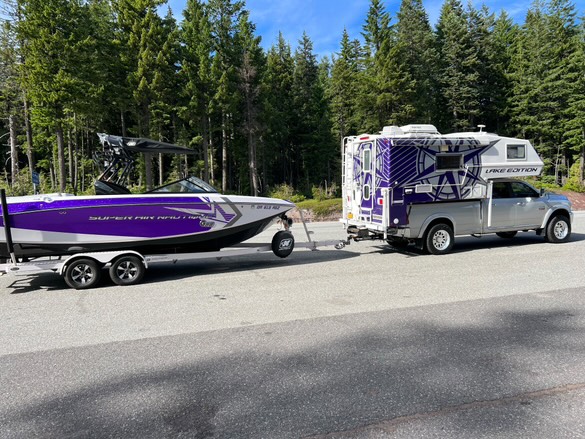
You loaded the camper, hitched up the boat trailer, and realized the receiver is buried behind the camper's rear overhang. The coupler cannot reach it. A hitch extension seems like the obvious solution: add reach and connect the trailer. But towing behind a truck camper with an extension is not the same as towing from a bare receiver. The extension length, the leverage it creates, the tongue weight at the end of that lever arm, and the ratings of every component in the chain all matter.
This article answers the basic question: can you tow with a hitch extension behind a truck camper? The answer is yes, when the entire towing system is rated for the extension length, the trailer weight, the tongue weight, and the truck's published limits.
Why Camper Overhang Changes the Towing Setup
When a truck camper extends past the rear bumper, the receiver is no longer at the back of the vehicle. It is somewhere behind the camper's rear wall, covered by the overhang. To reach behind the camper, you need a hitch extension that moves the ball or coupler connection point farther back. That extension creates a lever arm, and the longer the lever, the more force the tongue weight exerts on the receiver, the frame, and the rear axle.
This is why a hitch extension for truck camper towing is not just about reach. It is about rated capacity at a specific length.
What Makes an Extension Different from Towing Directly
When you tow directly from the receiver, the tongue weight load is close to the axle and the frame. The lever arm is short. When you add an extension, the tongue weight is applied at the end of a longer arm, amplifying the forces on the hitch, receiver, and truck. A 500-pound tongue weight at the end of a 42-inch extension creates significantly more stress on the system than the same 500 pounds at the receiver itself.
What to Check Before Towing Behind a Truck Camper
| What to Check | Why It Matters | Torklift Product to Consider | What to Verify |
| Camper overhang distance | Determines how much extension you need. | SuperTruss: rated hitch extension by length. | Measure from the receiver to the point the trailer coupler needs to connect. |
| Extension length rating | Longer extensions reduce capacity. The extension must be rated for the required length. | SuperTruss: published ratings by length. | Check current SuperTruss rating chart for your required length. |
| Tongue weight at extension | Tongue weight at the end of an extension is amplified by leverage. | SuperTruss + SuperHitch: designed for truck camper towing heavy loads. | Confirm tongue weight stays within the extension rating at the required length. |
| Truck towing capacity | The truck's factory limits are the ultimate ceiling. | SuperHitch: heavy-duty receiver system for truck camper towing. | Check the truck owner's manual. No hitch or extension increases factory limits. |
| Receiver rating | The receiver must be rated for the forces the extension creates. | SuperHitch: designed as a heavy-duty receiver for camper towing. | Confirm receiver rating is adequate for the extension and trailer. |
| Lowest-rated component | The weakest link in the chain controls the entire system. | All ratings must be checked: truck, hitch, extension, ball mount, coupler. | Verify every component. The lowest number is the system limit. |
What Is SuperTruss?
SuperTruss is Torklift's rated hitch extension for truck camper towing and has the highest towing ratings of any hitch extension in the industry. It is engineered with a truss design to manage the leverage forces that standard tube extensions cannot handle at longer lengths. SuperTruss has published ratings by length, so customers can choose the extension that matches their camper overhang and verify that the rating supports their trailer weight and tongue weight.
What Is SuperHitch?
SuperHitch is Torklift's heavy-duty receiver system designed for truck camper towing applications. It provides the receiver foundation that SuperTruss connects to. Together, SuperHitch and SuperTruss form the highest rated towing system for truck camper owners who need to tow behind camper overhang.
Recommended Torklift Hitch Setup
For truck camper owners who need to tow behind camper overhang: SuperHitch (receiver) + SuperTruss (rated extension). Measure camper overhang, check the SuperTruss rating chart for the required length, verify truck capacity, and confirm all ratings before purchasing.
Contact Torklift support for truck-specific fitment and rating guidance.
Key Takeaways
- Towing behind a truck camper with a hitch extension is possible when the entire system is rated for the extension length, trailer weight, and tongue weight.
- Extension length creates leverage. Longer extensions reduce capacity. The extension must be rated for the required length.
- SuperTruss is Torklift's rated hitch extension with published ratings by length. SuperHitch is the receiver foundation.
- The lowest-rated component in the system controls. Check truck, hitch, extension, ball mount, and coupler ratings.
- Measure camper overhang and check the rating chart before buying.
View SuperTruss and check the rating chart.
Frequently Asked Questions
Can you tow with a hitch extension behind a truck camper?
Yes, when the entire system is rated for the extension length, trailer weight, tongue weight, and truck limits.
Why does camper overhang matter?
It determines how much extension is needed, which affects leverage and capacity.
Does a longer extension reduce towing capacity?
Yes. Longer extensions increase leverage, which reduces the rated capacity at that length.
What is SuperTruss?
Torklift's rated hitch extension for truck camper towing, with published ratings by length.
What is SuperHitch?
Torklift's heavy-duty receiver system designed for truck camper towing applications.
How do I know what setup I need?
Measure camper overhang, check the SuperTruss rating chart, verify truck capacity, and contact Torklift support.