


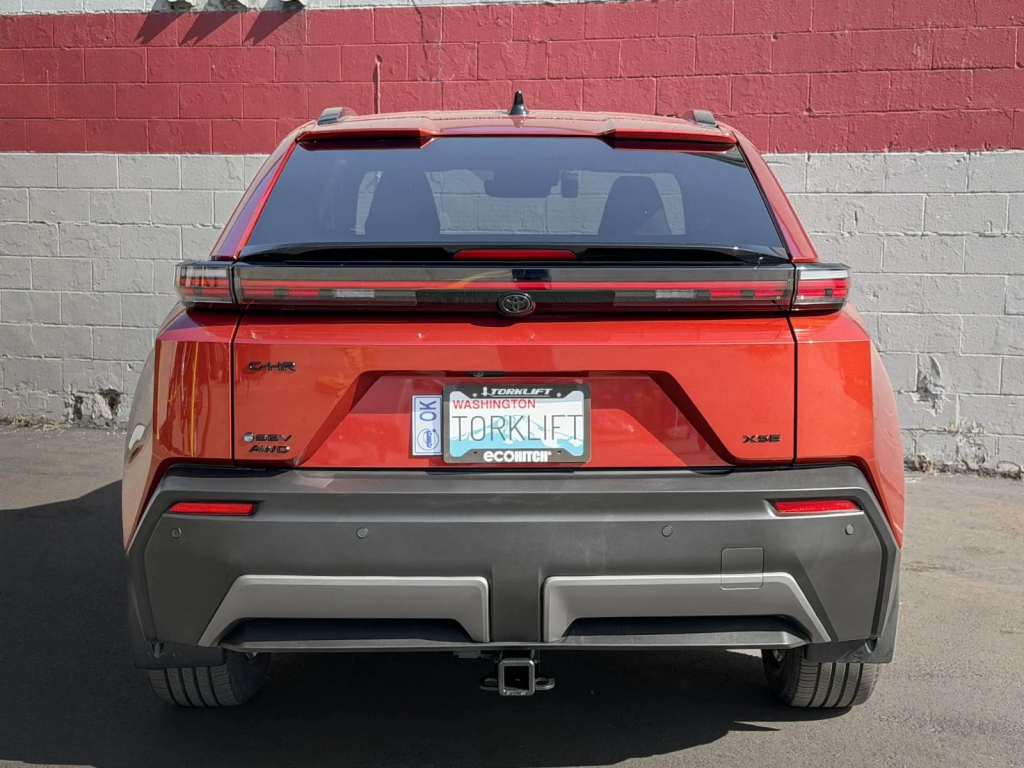
Appearance, ground clearance, kick sensor, stainless steel, and why the design of the hitch matters as much as the rating.
This content is accurate as of June 19, 2026. Fitment details may change, so for the latest information, please visit the EcoHitch product page.
The most common hesitation we hear from 2026 Toyota C-HR owners considering a trailer hitch is not about weight ratings or receiver size. It is about appearance. Will a hitch ruin the look of my car? Will there be a bulky steel bar hanging below the bumper? Will it scrape on my driveway? Will it mess with my kick sensor? These are legitimate concerns, especially on an all-electric compact SUV that owners chose, in part, because of how it looks.
The design of a trailer hitch determines whether those concerns become real problems or non-issues. This article breaks down the difference between a hidden hitch and a low-hanging exposed hitch, what each design means for the 2026 C-HR, and why the EcoHitch X7540SC was engineered to resolve every one of those concerns.
Will a Trailer Hitch Ruin the Look of My 2026 Toyota C-HR?
It depends entirely on the hitch design. A conventional exposed trailer hitch installs beneath the rear bumper with its structural cross tube, mounting brackets, and receiver tube fully visible from behind the vehicle. On a truck or a traditional SUV, that exposed hardware is expected and often ignored. On a 2026 Toyota C-HR, an all-electric compact SUV with sculpted rear bodywork, a visible steel crossbar beneath the bumper changes the entire rear appearance of the vehicle.
A hidden trailer hitch for the 2026 Toyota C-HR solves this by concealing the structural components behind the bumper and within the vehicle's rear profile. The EcoHitch X7540SC is a hidden design: when installed, only the 2-inch receiver opening is visible. The cross tube is concealed. The mounting frame is hidden. When the hitch pin and accessory are removed, the receiver disappears into the rear of the vehicle.
The C-HR's clean rear design stays intact. The receiver is there when you need it and invisible when you do not.
What a Hidden Hitch Design Actually Means
A hidden hitch is not simply a smaller hitch. It is a fundamentally different approach to how the hitch structure relates to the vehicle's body.
- Structural frame: Mounted behind the bumper and within the vehicle's frame rails, not exposed below the bumper line.
- Concealed cross tube: The load-distributing member is enclosed within the hitch body, protecting it from road debris, salt, moisture, and impact while keeping it out of sight.
- Receiver position: Integrated into the bumper opening rather than protruding below it. The EcoHitch X7540SC uses an upward receiver angle to keep the receiver tucked and to help maintain ground clearance.
- Visual profile: When no accessory is mounted, the receiver is the only component visible from the rear. No crossbar. No hanging brackets. No bolt heads.
A low-hanging exposed hitch, by contrast, positions its cross tube and mounting brackets below the bumper. The entire hitch structure is visible, adding visual weight to the rear of the vehicle and lowering the effective ground clearance.
Ground Clearance: Why Receiver Position Matters on the 2026 C-HR
The 2026 Toyota C-HR is a compact SUV, not a lifted truck. Its ground clearance is designed for on-road driving, urban parking, and the kinds of surfaces most owners encounter daily: steep driveways, parking garage transitions, speed bumps, and curbed lot entrances. A hitch that hangs below the bumper line reduces that clearance and creates a contact point that did not exist when the vehicle left the factory.
The EcoHitch X7540SC addresses this with an upward receiver angle integrated into the bumper. The receiver sits higher than it would in a straight or downward-angled configuration, helping to maintain the C-HR's factory ground clearance profile. For owners who have scraped a low-hanging hitch on a parking ramp or a steep driveway transition, the difference between an angled-up receiver and a straight-hanging receiver is not theoretical. It is the difference between clearing the obstacle and leaving metal on the concrete.
The concealed cross tube contributes here as well. An exposed cross tube hanging below the bumper is the lowest point of the hitch and the first thing to contact an obstruction. A concealed cross tube is not in the danger zone at all.
Stainless Steel vs. Standard Steel: The Long-Term Difference
Most trailer hitches use standard steel receivers with a painted or zinc-coated finish. That finish protects the steel from corrosion, but only until it wears through. And it always wears through, because the receiver tube is a friction zone. Every time a bike rack, ball mount, or cargo tray is inserted and removed, the coating wears at the contact points. Once exposed, the steel rusts.
The consequences of receiver rust are not just cosmetic:
- Orange corrosion stains appear on driveways, garage floors, and any concrete surface where the vehicle parks. For a homeowner or an HOA-conscious driver, those stains are a visible and persistent problem.
- Interior receiver corrosion causes accessories to bind. A bike rack that slid in easily when the receiver was new can become extremely difficult to remove after two seasons of rust buildup. In severe cases, accessories can become effectively seized inside the receiver.
- Structural integrity of the receiver wall degrades as corrosion progresses from the surface inward.
The EcoHitch X7540SC uses a patent-pending stainless steel receiver. Stainless steel is corrosion-resistant throughout its cross-section, not just at the surface. There is no coating to wear through. The receiver resists rust, resists binding, does not stain parking surfaces, and maintains its structural and functional integrity over the ownership life of the vehicle.
For a 2026 C-HR owner who plans to use the hitch for years, not months, the stainless steel receiver is the material choice that eliminates the most common receiver problems before they start.
Sensor Safe™: Keeping the C-HR's Kick Sensor Working
The 2026 Toyota C-HR includes a hands-free kick sensor for the power liftgate. Wave your foot under the rear bumper and the liftgate opens. It is a convenience feature that C-HR owners rely on when their hands are full.
A hitch that places structural components or an exposed cross tube in the kick sensor zone can interfere with or disable this feature. The sensor reads motion in a specific area beneath the bumper, and any metal obstruction in that zone can block or confuse the signal.
The EcoHitch X7540SC is designed with Sensor Safe compatibility. The hidden design and concealed cross tube route the hitch structure away from the sensor's operating zone. The kick sensor continues to function as designed. You do not lose the convenience feature you paid for when you add the hitch.
If kick sensor compatibility is a factor in your hitch decision, confirm that any hitch you consider explicitly addresses sensor zone clearance. Do not assume that a generic hitch with an exposed cross tube will avoid the sensor area on a vehicle like the C-HR.
What to Look for Before Choosing a Hitch for a New EV
If you are shopping for a hitch for the 2026 Toyota C-HR or any new EV, here is what we recommend evaluating:
- Receiver size: A 2-inch receiver provides the widest accessory compatibility without adapters. The EcoHitch X7540SC uses a standard 2-inch receiver.
- Design: Hidden vs. exposed. A hidden design preserves the vehicle's factory appearance and protects ground clearance. An exposed design adds visual bulk and lowers the rear profile.
- Receiver material: Stainless steel resists corrosion, binding, and staining. Standard steel relies on coatings that wear through over time.
- Sensor compatibility: Confirm the hitch is designed to maintain kick sensor or hands-free liftgate function. The EcoHitch X7540SC is Sensor Safe™.
- Installation: A bolt-on installation with no drilling or full bumper removal is preferred. The EcoHitch X7540SC is 100% bolt-on.
- Warranty: A manufacturer-backed lifetime warranty from the company that engineered the hitch. Torklift's Legendary Lifetime Warranty covers the EcoHitch X7540SC.
2026 Toyota C-HR EcoHitch: Quick Specs
| Specification | Detail |
| Product | 2026 Toyota C-HR Stainless Steel EcoHitch Trailer Hitch |
| Part Number | X7540SC |
| Vehicle Fitment | 2026 Toyota C-HR |
| Receiver Type | Hidden |
| Receiver Size | 2-inch |
| Receiver Material | Stainless steel (patent pending) |
| Towing Weight Rating | 3,500 lbs |
| Tongue Weight Rating | 450 lbs at the trailer ball |
| Sensor Compatibility | Sensor Safe™: designed to maintain hands-free kick sensor functionality |
| Installation | 100% bolt-on, no drilling required. Kit ships complete with bolt and accessory kits. |
| Safety Standards | Meets SAE J684 national towing safety standards |
| Product Status | Available Now |
| Origin | Made in the U.S.A. |
| Warranty | Legendary Lifetime Warranty |
Key Takeaways
- A hidden hitch preserves the 2026 C-HR's clean rear appearance by concealing the structural frame and cross tube behind the bumper. Only the 2-inch receiver is visible.
- A low-hanging exposed hitch adds visual bulk, reduces ground clearance, and can interfere with the hands-free kick sensor. The EcoHitch avoids all three.
- The stainless steel receiver resists corrosion throughout the material, preventing rust stains, accessory binding, and structural degradation that affect standard steel receivers over time.
- Sensor Safe™ design maintains the C-HR's hands-free kick sensor function by routing hitch structure away from the sensor zone.
- The EcoHitch X7540SC is available now, 100% bolt-on, meets SAE J684 standards, is Made in the U.S.A., and is backed by Torklift's Legendary Lifetime Warranty.
The 2026 Toyota C-HR was designed as a clean, modern EV. The EcoHitch X7540SC was engineered to add receiver utility without contradicting that design. No exposed crossbar. No rust. No lost kick sensor. No scraping.
Frequently Asked Questions: Hidden Hitch for the 2026 Toyota C-HR
What is a hidden hitch for a 2026 Toyota C-HR?
A hidden hitch conceals the structural frame, cross tube, and mounting hardware behind the vehicle's rear bumper profile. Only the 2-inch receiver opening is visible when installed. The EcoHitch X7540SC is a hidden design engineered for the 2026 C-HR.
Will a hitch ruin the look of my Toyota C-HR?
Not if it is a hidden design. The EcoHitch X7540SC is engineered so that only the receiver is visible when installed. The concealed cross tube, structural frame, and hardware are all tucked behind the bumper. When no accessory is mounted, the receiver blends into the rear of the vehicle.
Why does ground clearance matter on a C-HR hitch?
The 2026 C-HR is a compact SUV with on-road ground clearance designed for urban driving, steep driveways, parking garages, and speed bumps. A hitch that hangs below the bumper reduces that clearance and creates a scraping risk. The EcoHitch uses an upward receiver angle to help maintain factory ground clearance.
What is the difference between a hidden hitch and a low-hanging hitch?
A hidden hitch conceals its structural components behind the bumper, with only the receiver visible. A low-hanging hitch exposes its cross tube, brackets, and receiver below the bumper line, adding visual bulk and reducing ground clearance.
Does the Toyota C-HR EcoHitch keep the kick sensor working?
Yes. The EcoHitch X7540SC is designed with Sensor Safe™ compatibility. The hidden design routes the hitch structure away from the kick sensor's operating zone, maintaining hands-free liftgate function.
Why does an upward receiver angle matter?
An upward receiver angle helps the receiver sit higher within the bumper profile, maintaining ground clearance and reducing scraping risk. It also helps keep hitch-mounted accessories level during use.
Is a stainless steel receiver worth it?
For long-term ownership, yes. A stainless steel receiver resists the corrosion that causes rust stains on parking surfaces, prevents accessories from binding inside the receiver, and maintains structural integrity without relying on a surface coating that wears through with repeated accessory insertion and removal.
IMPORTANT NOTICE:
While EcoHitch trailer hitches are built with high-strength materials and tested for exceptional weight ratings, your vehicle's factory towing capacities are the ultimate limit. Always refer to your vehicle's owner's manual to determine its maximum towing and tongue weight ratings. No aftermarket hitch or accessory can increase your vehicle's factory-rated towing capacities.
Using hauling accessories like extensions, cargo trays, bike racks, or other accessories that extend the load out from the trailer hitch, will significantly reduce the tongue weight capacity of your hitch system.
To estimate how your setup will affect tongue weight, we recommend using our Maximum Hitch Weight (Tongue Weight) Estimator before hauling your payload (cargo trays, bike racks, etc).
Disclaimer: It is the user's responsibility to ensure safe towing practices and to confirm that all loads fall within the limits of the lowest-rated component in the towing system. Torklift is not liable for any damage or injury resulting from the misuse or overloading of towing/hauling equipment.