


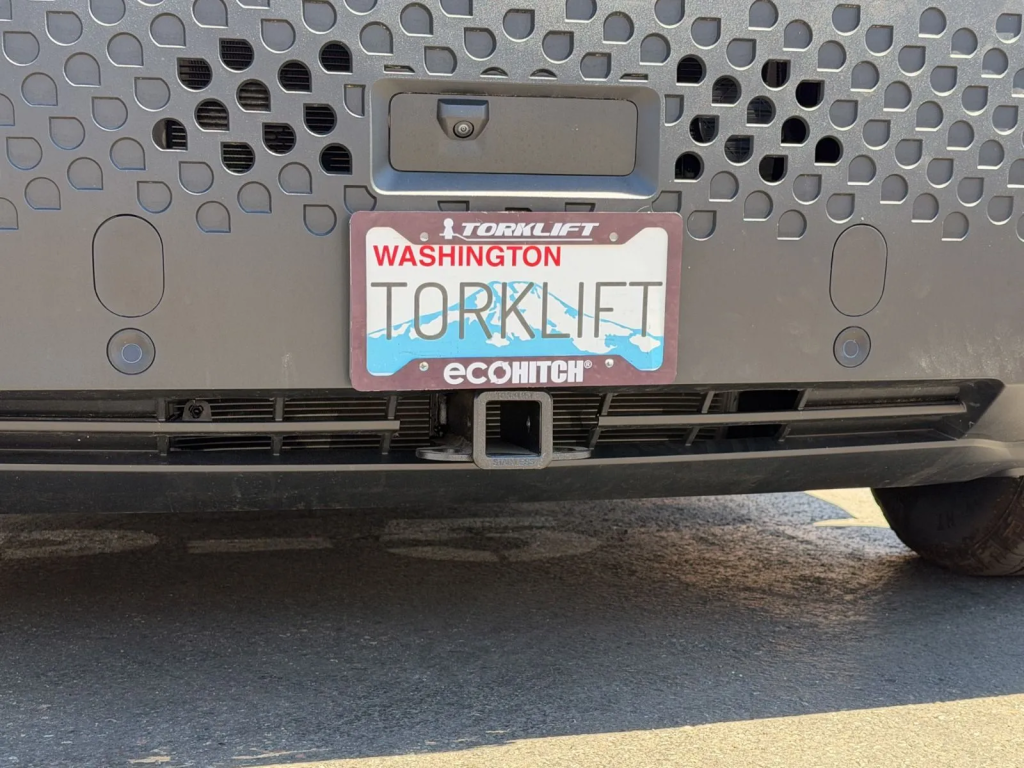
Snow plows, winches, cargo trays, bike racks, and more. A practical guide to front-mounted receiver capability for the BrightDrop 400 and BrightDrop 600.
This content is accurate as of June 19, 2026. Fitment details may change, so for the latest information, please visit the NorthHitch product page.
The Chevrolet BrightDrop offers one of the largest cargo areas in the commercial EV van class. For last-mile delivery, that interior volume is the whole point. But the moment a fleet operator, facilities team, or service crew needs equipment mounted outside the van, visible from the cab, or positioned where it does not compete with interior cargo space, the conversation changes. The rear of the van is already spoken for. The front of the van, without a receiver hitch, has nothing to offer.
This article covers the practical use cases for a front receiver hitch on the 2022-2026 Chevrolet BrightDrop: what you can mount, which scenarios benefit most, and why the Torklift NorthHitch X7924S gives BrightDrop 400 and BrightDrop 600 operators a clean, properly engineered way to add front-mounted utility without compromising ground clearance or fitment quality.
Why Front-Mounted Receiver Capability Matters on a Commercial Van
A front receiver hitch on a commercial van is not a novelty accessory. It solves a specific operational problem: the rear of the vehicle is already the primary work zone. Rear doors open and close dozens of times per shift. Cargo is loaded and unloaded from the back. Rear-mounted accessories interfere with that workflow, create access delays, and in some cases prevent the doors from opening fully.
Moving utility equipment to the front of the vehicle does three things. First, it frees the rear for unobstructed cargo operations. Second, it puts mounted equipment within the driver's line of sight during approach and maneuvering, which matters for snow plows, winch operations, and any front-mounted gear that needs to be monitored while the vehicle is moving. Third, it expands what the BrightDrop can do beyond its factory role as a cargo transport, without modifying the cargo area or compromising its primary function.
For fleet managers evaluating BrightDrop front hitch uses, the question is straightforward: what work does your BrightDrop need to do beyond carrying cargo, and where on the vehicle does that equipment belong?
Front Cargo Trays and Equipment Carriers
Consider a service fleet running BrightDrop vans for facilities maintenance. The interior is loaded with parts, materials, and supplies. But the crew also carries large format items that are awkward to stow inside: conduit bundles, PVC piping, signage, or bulky toolboxes that eat into the cargo footprint. A front-mounted cargo tray gives that equipment a dedicated position outside the van, preserving full interior cargo volume for the items that need to ride inside.
A BrightDrop cargo carrier mounted at the front works the same way a rear cargo carrier would, but without blocking the rear doors. The tray slides into the 2-inch front receiver, loads are secured on the platform, and the driver has a clear sightline to the equipment during every approach and maneuver.
Why Flush-to-Bumper Receiver Design Matters for Cargo Accessories
Not every front hitch seats accessories the same way. A receiver that sits recessed behind the bumper often requires an extender to bring the accessory forward to a usable position. Extenders add a pivot point that introduces play, vibration, and lateral instability, particularly under load. The NorthHitch X7924S uses a flush-to-bumper receiver design: the 2-inch receiver opening sits at the bumper face, so standard 2-inch accessories seat directly without adapters or extensions. That means less rattle, more stable loads, and a shorter moment arm between the receiver and the carried weight.
For a crew loading a front cargo tray with 50 to 100 pounds of tools every morning, that direct seat makes a material difference in stability over the course of a shift.
Snow Plows and Winter Equipment: Using a BrightDrop for Seasonal Work
One of the most common questions we hear from municipal operators and facilities teams: can a BrightDrop use a snow plow? The mechanical answer is that a front receiver hitch provides the mounting point for plow adapter plates designed for 2-inch receivers.
A front hitch designed for the BrightDrop makes winter versatility possible without dedicating a separate vehicle to the task. A facilities team running a BrightDrop for campus maintenance, for example, can use the same vehicle for supply delivery during spring and summer and mount a light-duty plow adapter in winter. The vehicle does double duty. The fleet does not expand.
Ground Clearance and Approach Angle
Ground clearance is especially critical for a BrightDrop snow plow hitch application. A low-hanging front hitch reduces the vehicle's approach angle, which increases the risk of the hitch or mounted equipment scraping on uneven surfaces, curbs, parking stops, snow berms, and driveway transitions. The NorthHitch X7924S uses an angled-up receiver integrated into the bumper, specifically designed to maintain the BrightDrop's ground clearance rather than compromise it. For any operator considering winter use, that clearance protection is not optional; it is a basic requirement for safe and effective operation.
Front-Mounted Winch and Recovery Capability
For commercial operators running BrightDrop vans on service routes that include unpaved access roads, remote job sites, or soft ground conditions, a front-mounted winch can turn an immobilized vehicle into one that recovers itself. Without a front receiver hitch, there is no clean way to mount a winch at the front of the BrightDrop. With the NorthHitch X7924S in place, a receiver-mounted winch cradle slides into the 2-inch receiver and provides a forward-facing recovery point.
The NorthHitch X7924S is rated for 10,000 pounds of line pull. That rating is the hitch's rating, which means the hitch mounting structure is engineered to handle up to 10,000 pounds of pulling force when a winch is engaged.
What a front-mounted BrightDrop winch mount adds to a fleet is self-recovery capability without waiting for a tow truck. For a service crew on a time-sensitive route, that can be the difference between a 20-minute self-recovery and a multi-hour wait for roadside assistance.
Bike Racks, Gear Carriers, and Front-Mounted Accessories
Not every BrightDrop front hitch use case is heavy commercial. Some operators want a BrightDrop bike rack solution that keeps the rear doors fully accessible. A front-mounted bike rack in a 2-inch receiver carries bikes at the front of the vehicle, which means no rear-door interference, no need to unload the rack before opening the cargo area, and direct visibility of the mounted bikes during driving and parking.
This same logic applies to any front-mounted gear carrier or accessory platform. A recreation fleet, a corporate campus shuttle, or a crew van that carries employee gear alongside delivery cargo can use the front receiver for equipment that would otherwise compete with cargo space or block the rear doors.
Stainless Steel: Why It Matters for Accessory Cycling
Every time an accessory is inserted into or removed from a receiver, it creates metal-on-metal contact. On a standard painted or zinc-coated steel receiver, that contact gradually wears through the protective coating. Once the coating is compromised, moisture enters, corrosion begins, and two problems follow. First, the receiver itself starts to rust, which produces corrosion stains on shop floors, driveways, customer sites, and concrete wherever the vehicle parks. Second, the interior of the receiver tube develops surface corrosion that can cause accessories to bind, making removal difficult or requiring force that damages the accessory, the receiver, or both.
The NorthHitch X7924S uses a patent-pending stainless steel receiver. Stainless steel is corrosion-resistant throughout the material, not just at the surface. Repeated accessory insertion and removal does not expose a vulnerable substrate. The receiver resists rust, resists binding, and does not leave corrosion stains on surfaces where the vehicle parks. For a fleet vehicle that may cycle accessories daily and park at customer locations, that material choice has operational and professional appearance implications that go well beyond the receiver itself.
Why the NorthHitch X7924S Is Engineered for This Job
Every use case described above depends on the front hitch being properly engineered for the BrightDrop. A generic front hitch, or one adapted from a different vehicle platform, introduces fitment compromises: wrong receiver position, reduced ground clearance, exposed structural members, or a receiver that requires extenders to function with standard accessories.
The Torklift NorthHitch for the 2022-2026 Chevrolet BrightDrop (SKU X7924S) was developed for this vehicle specifically. It fits both the BrightDrop 400 and BrightDrop 600, and it addresses the engineering requirements that make a front hitch viable for daily commercial use:
- Flush-to-bumper 2-inch receiver: Standard accessories seat directly, no extenders or adapters required.
- Stainless steel receiver (patent pending): Corrosion-resistant throughout the material. No surface rust, no accessory binding, no corrosion stains.
- Angled-up receiver integrated into the bumper: Maintains ground clearance rather than reducing it.
- Concealed cross tube: The structural load-distribution member is integrated within the hitch body, reducing debris and environmental exposure.
- 750 pounds tongue weight at the trailer ball: Rated for substantial front cargo loads and accessory configurations.
- 10,000 pounds line pull: Rated for receiver-mounted winch and recovery applications.
- Legendary Lifetime Warranty: Backed by Torklift's manufacturer warranty.
- Built in the USA: Manufactured at Torklift's facility in Washington state.
When you buy direct from Torklift, the fitment data, the product support, and the warranty come directly from the engineering team that designed the hitch for your BrightDrop. That is a different level of confidence than purchasing through a third-party aggregator who is several steps removed from the people who made the product.
Key Takeaways
- A front receiver hitch on the 2022-2026 Chevrolet BrightDrop adds front-mounted utility for cargo trays, snow plows, winches, bike racks, and specialized equipment, while keeping the rear doors fully accessible.
- The Torklift NorthHitch X7924S is engineered specifically for the BrightDrop 400 and BrightDrop 600, with a flush-to-bumper 2-inch stainless steel receiver, angled-up receiver geometry, and concealed cross tube for clean fitment and protected ground clearance.
- The stainless steel receiver resists corrosion, prevents accessory binding from rust buildup, and eliminates corrosion stains on parking surfaces, a meaningful advantage for fleet vehicles that park at customer locations.
- The NorthHitch is rated for 750 pounds tongue weight and 10,000 pounds line pull.
- Buying direct from Torklift means factory-direct fitment data, manufacturer support, and the Legendary Lifetime Warranty.
The BrightDrop was engineered to maximize cargo efficiency. The NorthHitch X7924S extends what the vehicle can do by adding front-mounted receiver capability without compromising the clean fitment, ground clearance, or professional-grade quality that a commercial fleet demands.
Frequently Asked Questions: Front Hitch Uses for the 2022-2026 Chevrolet BrightDrop
What can you use a front hitch for on a Chevy BrightDrop?
A front receiver hitch on the BrightDrop adds mounting capability for a range of front-mounted accessories: cargo trays and equipment carriers, snow plow adapter plates, recovery winches, bike racks, and specialized utility gear. The key advantage is that front-mounted accessories keep the rear doors fully accessible for unobstructed cargo operations.
Can a BrightDrop use a front-mounted winch?
Yes, with the right setup. The Torklift NorthHitch X7924S provides a 2-inch front receiver rated for 10,000 pounds of line pull, which is the hitch's structural rating for winch operations.
Can a BrightDrop use a snow plow or snow equipment?
A front receiver hitch provides the mounting point for plow adapter plates designed for 2-inch receivers. The NorthHitch X7924S uses an angled-up receiver and maintains ground clearance, both of which are important for safe and effective winter operation.
Can you use a front hitch for cargo trays or bike racks on a BrightDrop?
Yes. A 2-inch front receiver accepts standard receiver-mounted cargo trays, bike racks, and equipment carriers. The NorthHitch X7924S uses a flush-to-bumper receiver design, which allows accessories to seat directly without extenders or adapters, reducing rattle and improving load stability compared to recessed-receiver configurations that require extension tubes.
Why would a fleet want a front receiver instead of only using the rear of the vehicle?
The rear of the BrightDrop is the primary cargo access point, and rear-mounted accessories can interfere with loading, unloading, and door operation. A front receiver moves utility equipment to the front of the vehicle, keeping the rear clear for cargo work while placing mounted gear within the driver's line of sight for safer maneuvering.
Why does a flush-to-bumper 2-inch receiver help with accessories?
A flush-to-bumper receiver seats the accessory directly at the bumper face. A recessed receiver often requires an extender to bring the accessory forward to a usable position, and that extender introduces an additional pivot point that can cause lateral play, vibration, and instability under load. The NorthHitch's flush-to-bumper design eliminates that extender requirement for a more stable, more secure accessory mount.
Why is ground clearance important on a front hitch?
A front hitch that hangs below the bumper line reduces the vehicle's approach angle, increasing the risk of the hitch or mounted equipment contacting curbs, parking stops, loading dock edges, and uneven road surfaces. The NorthHitch X7924S uses an angled-up receiver geometry integrated into the bumper to maintain the BrightDrop's ground clearance and protect the hitch from unnecessary contact damage.
IMPORTANT NOTICE:
While NorthHitch trailer hitches are built with high-strength materials and tested for exceptional weight ratings, your vehicle’s factory towing capacities are the ultimate limit. Always refer to your vehicle’s owner’s manual to determine its maximum towing and tongue weight ratings. No aftermarket hitch or accessory can increase your vehicle’s factory-rated towing capacities.
Using hauling accessories like extensions, cargo trays, bike racks, or other accessories that extend the load out from the trailer hitch, will significantly reduce the tongue weight capacity of your hitch system.
To estimate how your setup will affect tongue weight, we recommend using our Maximum Hitch Weight (Tongue Weight) Estimator before hauling your payload (cargo trays, bike racks, etc).
Disclaimer: It is the user’s responsibility to ensure safe towing practices and to confirm that all loads fall within the limits of the lowest-rated component in the towing system. Torklift is not liable for any damage or injury resulting from the misuse or overloading of towing/hauling equipment.