


The difference between a step that hangs and a step that lands. Why it changes everything about campsite entry.
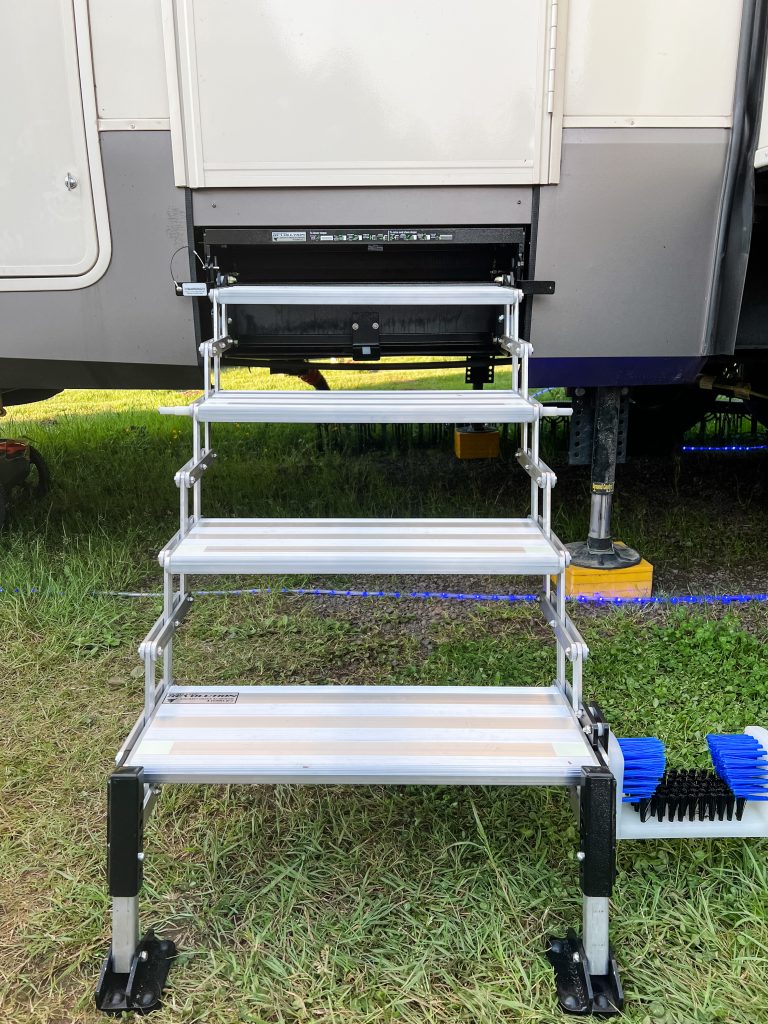
Most factory RV steps hang in the air. They are connected to the RV at the top and suspended at the bottom. When you step on them, the entire load is borne by the hinge point. That is why they bounce. Ground-contact steps change the physics by transferring part of the load to the surface below. This article explains why that matters.
What Changes When Steps Reach the Ground
A step that contacts the ground becomes a supported structure. The load from the person on the step is shared between the RV mounting point and the ground surface. The bounce caused by cantilevered leverage is reduced or eliminated. The step feels solid because it is being supported from below.
Why Hanging Steps Feel Bouncy
A hanging step is a lever arm. The mounting point is the pivot. The person standing on the bottom step is applying force at the end of the arm. The farther the step from the pivot, the more leverage, the more bounce. On uneven ground, where the bottom step is even farther from any surface, the effect is amplified.
Ground-Contact Step Features
| Step Feature | What It Does | Why It Matters |
| Extends to ground | The step system reaches the campsite surface. | Eliminates the cantilevered bounce. Load is shared. |
| Adapts to terrain | Step length adjusts to the surface height. | Campsites are rarely level. The step needs to meet whatever surface is there. |
| Glow-in-the-dark surfaces | Step treads glow for low-light visibility. | Campsite entries are dark. Visible steps reduce missteps. |
| All Terrain Landing Gear | Adjustable feet for soft or uneven surfaces. | Gravel, mud, and soft dirt challenge standard step feet. |
| Exterior storage | Steps fold into the step well and store outside during travel. | No road debris brought inside the RV. |
How Ground Contact Helps at Uneven Campsites
When the campsite is sloped, the effective entry height changes. The side of the RV facing downhill has a taller entry. A step system that extends to the ground adapts to that change. A hanging step system does not. It stays the same length regardless of the surface, which means the gap between the bottom step and the ground gets larger on the downhill side.
Recommended Torklift Step System
GlowStep Revolution for step-well mounted ground contact. Equipped with All Terrain Landing Gear for additional terrain stability and Earth to RV connection eliminates diving board effect common with factory RV steps. Measure the step-well opening before ordering.
Key Takeaways
- Ground contact changes the physics. The load is shared between the RV and the surface.
- Hanging steps bounce because they are cantilevered. Ground contact eliminates the leverage problem.
- GlowStep Revolution is designed for ground contact and terrain adaptation.
- Measure before ordering.
Frequently Asked Questions
Why does ground contact matter?
It shares the load between the RV and the ground, eliminating the cantilevered bounce of hanging steps.
Why do hanging steps feel bouncy?
They are lever arms. The mounting point is the pivot. The person on the bottom step applies force at the end of the arm.
How does ground contact help at uneven campsites?
The step extends to meet the surface, adapting to slopes and uneven terrain rather than hanging at a fixed length.
What is GlowStep Revolution?
Torklift's step-well mounted step system designed for ground contact, terrain adaptation, and exterior storage.
What should I measure?
Step-well opening width and depth. Entry height with the RV level.